-
Shop
- Advanced Technologies
- AI Skills Mastery 2026 Collection
- Apple Accessories
- Arts, Crafts & Hobbies
- Best-Sellers
- Calvin Klein
- Car Accessories
- Christmas Collection
- Dating & Social Skills
- Denim
- 7FOR
- AGOLDE
- Antony Morato
- Armani Exchange
- Boss
- Brunello Cucinelli
- Calvin Klein Jeans
- Costume National
- Desigual
- Diesel
- Dolce & Gabbana
- Dsquared²
- Ermanno Scervino
- Fendi
- Gianni Lupo
- Guess Jeans
- Ichi
- Just Cavalli
- Lee
- Levi's
- Liu Jo
- Morgan De Toi
- Mother Denim
- Only
- Pepe Jeans
- Pinko
- Replay
- Tommy Hilfiger Jeans
- Valentino
- Vero Moda
- Digital Resources
- Car Buying & Ownership
- Cozy Feast Collection
- Emotional Intelligence
- Financial Education
- Home Styling & Organization
- Mindfulness
- Mindset
- Parenting & Child Development
- Pet Lifestyle & Wellness
- Positive Thinking
- Productivity
- Self Confidence
- Sleep Improvement
- Stress Management & Relaxation
- Travel Planning
- Yoga & Fitness
- Yoga & Mind-Body Practices
- Education & Learning
- Family & Parenting
- Fashion
- Accessories
- Alexander McQueen
- Bags
- Bags & Wallets
- Balenciaga
- Belts
- Blazers
- Blouses & Shirts
- Bottega Veneta
- Bottoms
- Brunello Cucinelli
- Burberry
- Chanel
- Chloé
- Dior
- Dolce & Gabbana
- Dresses
- Etro
- Gucci
- Hats & Hair Accessories
- Hoodies & Sweatshirts
- Jacquemus
- Jewelry
- Jil Sander
- Jimmy Choo
- Kiton
- Luggage
- Luggage Bags
- Men's Fashion
- Miu Miu
- Off-White
- Outerwear
- Prada
- Rick Owens
- Saint Laurent
- Skirts
- Socks & Tights
- Sunglasses
- Sweaters & Cardigans
- The Row
- Tom Ford
- Tops & Shirts
- Valentino Garavani
- Versace
- Vivienne Westwood
- Watches
- Fashion Accessories
- Furniture
- Gadgets
- Health & Beauty
- Health & Wellness
- Home & Garden
- Home Supplies
- Kids & Babies
- Lighting
- Patio, Lawn & Garden
- Personal Growth
- Pet Care
- Pet Supplies
- Pets
- Shoes
- Sport & Outdoors
- Super Deals
- Thanksgiving Digital Collection
- AI & Tech-Enhanced Thanksgiving
- Budgeting & Smart Shopping
- Eco-Friendly & Sustainable Thanksgiving
- Family & Kids
- Gift Ideas Guides
- Gratitude & Mindfulness
- History & Meaning
- Hosting & Planning
- Leftovers & Storage
- Pets & Thanksgiving
- Social Media Captions & Ideas
- Thanksgiving DIY Ideas
- Thanksgiving Recipes
- Thanksgiving Products
- Travel
- Wealth
- Wealth Building
- Budgeting & Saving
- Cryptocurrency Investing
- Debt Management
- Entrepreneurship & Business Growth
- Family Finance & Budgeting
- Financial Independence
- Financial Mindset & Psychology
- Financial Planning
- Frugal Living & Expense Hacks
- Goal Setting
- High-Income Skills
- Investing Basics
- Leadership
- Motivation
- Networking & Mentorship
- Passive Income Strategies
- Real Estate Investing
- Side Hustles
- Stock Market Investing
- YouTube Shorts Best-Sellers
65W GaN USB-C Charger Guide: PD, QC, Cables
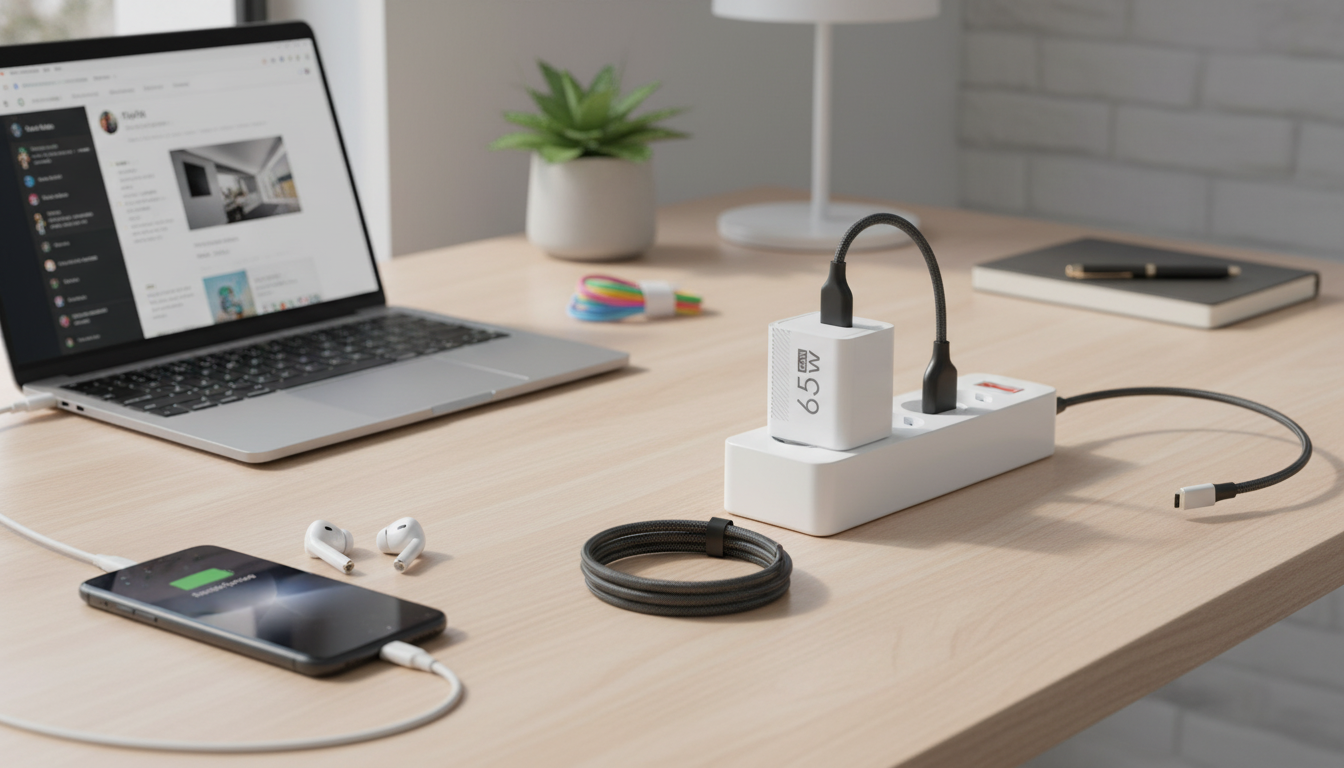
65W GaN USB‑C Fast Wall Charger with Quick Charge: Compact Power for Phones, Tablets, and Laptops
A 65W GaN wall charger is built for people who want one small power brick that can keep up with modern devices—from fast-charging phones to USB‑C tablets and many thin-and-light laptops. Thanks to gallium nitride (GaN) components, these chargers can often run cooler and pack more power into a smaller footprint than older silicon designs, making them a smart upgrade for travel bags, nightstands, and desk setups.
Below is a practical breakdown of what “65W” means day to day, how USB‑C Power Delivery and Quick Charge typically work, and what to check so you get the speed and safety you expect.
What a 65W GaN charger is built to do
A 65W USB‑C charger can deliver up to 65 watts when a connected device requests that much power. That’s a key point: the charger doesn’t “push” 65W into everything. Instead, your phone, tablet, or laptop negotiates for a specific charging profile and draws only what it supports.
Where 65W makes the biggest difference
- USB‑C laptops and ultrabooks: Many models charge happily at 45–65W, so a 65W adapter can replace the OEM brick for everyday work and travel.
- Tablets and handhelds: Larger batteries benefit from higher power headroom, especially when you’re using the device while charging.
- One-charger convenience: A single compact brick can cover a phone plus a laptop (separately) without packing multiple adapters.
To reach higher wattage reliably, pair the charger with a quality USB‑C to USB‑C cable. USB‑C Power Delivery (PD) charging at laptop-level wattages is heavily dependent on cable capability and connector quality.
Quick Charge vs USB‑C Power Delivery: how fast charging is negotiated
Most modern fast charging over USB‑C centers on USB Power Delivery (USB PD), a widely adopted standard used by many Android phones, iPads with USB‑C, power banks, and a long list of laptops. Quick Charge (QC), from Qualcomm, is another common system frequently found on Android devices; you can learn more from Qualcomm’s Quick Charge overview.
In practice, charging speed comes from a “handshake” between the charger and device. They agree on supported voltage/current options (often called profiles). Typical USB‑C PD options include 5V, 9V, 12V, 15V, and 20V, but the exact set varies by charger model and device. If fast-charging protocols aren’t supported, the connection usually falls back to basic charging (commonly 5V).
Common charging scenarios and what to expect
| Device type | Likely protocol | Typical power range | What limits speed |
|---|---|---|---|
| Android phone (QC/PD capable) | QC or USB PD | 18W–45W (varies) | Phone’s max input and battery temperature |
| iPhone (USB‑C/Lightning fast charge) | USB PD | 18W–27W (varies) | Phone’s max input and cable type |
| Tablet (USB‑C) | USB PD | 18W–45W (varies) | Tablet’s max input and active use while charging |
| USB‑C ultrabook | USB PD | 45W–65W (varies) | Laptop’s required wattage and whether it’s in use |
| Accessories (earbuds, watches) | Basic/Proprietary | 2.5W–10W | Accessory charge controller |
GaN’s role here is efficiency and compactness. GaN power devices can switch at higher frequencies and reduce energy losses compared with many older silicon designs; for a deeper technical overview, see Infineon’s GaN power devices explainer.
Compatibility checklist before buying (devices, cables, and charging habits)
Safety and longevity: heat, protections, and everyday best practices
When 65W is the right size (and when it isn’t)
Product snapshot: 65W GaN USB‑C Fast Wall Charger with Quick Charge
If you’re looking for an affordable entry into 65W GaN charging, the 65W GaN USB C Fast Wall Charger with Quick Charge is designed to deliver up to 65W in a compact GaN form factor for compatible USB‑C devices. It’s a practical pick for a travel kit or a streamlined desk setup—especially when paired with a properly rated USB‑C to USB‑C cable.
Key details
| Item | Value |
|---|---|
| Product | 65W GaN USB C Fast Wall Charger with Quick Charge |
| Price | 8.51 USD |
| Availability | In stock |
| Product page | View product |
More in-stock picks
- Men’s 1.25 Inch Woven Leather Belt – Retro Style (a simple travel staple that pairs well with a minimalist carry)
FAQ
Will a 65W charger charge a phone faster than a 20W charger?
Only if the phone supports a higher charging rate than 20W. Many phones cap their input around 18W–30W (some higher), so a 65W charger may not increase speed—but it can be more versatile for tablets and laptops.
Does Quick Charge work through USB‑C?
Some chargers support Quick Charge alongside USB Power Delivery. Your device and charger negotiate the best shared mode; if QC is supported it may use QC, otherwise it typically uses USB PD (or basic 5V charging).
What cable is needed for 65W USB‑C charging?
Use a quality USB‑C to USB‑C cable rated for the current required. Many 65W setups work with a 3A cable, while some higher-power PD profiles may require a 5A e‑marked cable.
Recommended for you



Was this article helpful?
Yes
No









Leave a comment