-
Shop
- Advanced Technologies
- AI Skills Mastery 2026 Collection
- Apple Accessories
- Arts, Crafts & Hobbies
- Best-Sellers
- Calvin Klein
- Car Accessories
- Christmas Collection
- Dating & Social Skills
- Denim
- 7FOR
- AGOLDE
- Antony Morato
- Armani Exchange
- Boss
- Brunello Cucinelli
- Calvin Klein Jeans
- Costume National
- Desigual
- Diesel
- Dolce & Gabbana
- Dsquared²
- Ermanno Scervino
- Fendi
- Gianni Lupo
- Guess Jeans
- Ichi
- Just Cavalli
- Lee
- Levi's
- Liu Jo
- Morgan De Toi
- Mother Denim
- Only
- Pepe Jeans
- Pinko
- Replay
- Tommy Hilfiger Jeans
- Valentino
- Vero Moda
- Digital Resources
- Car Buying & Ownership
- Cozy Feast Collection
- Emotional Intelligence
- Financial Education
- Home Styling & Organization
- Mindfulness
- Mindset
- Parenting & Child Development
- Pet Lifestyle & Wellness
- Positive Thinking
- Productivity
- Self Confidence
- Sleep Improvement
- Stress Management & Relaxation
- Travel Planning
- Yoga & Fitness
- Yoga & Mind-Body Practices
- Education & Learning
- Family & Parenting
- Fashion
- Accessories
- Alexander McQueen
- Bags
- Bags & Wallets
- Balenciaga
- Belts
- Blazers
- Blouses & Shirts
- Bottega Veneta
- Bottoms
- Brunello Cucinelli
- Burberry
- Chanel
- Chloé
- Dior
- Dolce & Gabbana
- Dresses
- Etro
- Gucci
- Hats & Hair Accessories
- Hoodies & Sweatshirts
- Jacquemus
- Jewelry
- Jil Sander
- Jimmy Choo
- Kiton
- Luggage
- Luggage Bags
- Men's Fashion
- Miu Miu
- Off-White
- Outerwear
- Prada
- Rick Owens
- Saint Laurent
- Skirts
- Socks & Tights
- Sunglasses
- Sweaters & Cardigans
- The Row
- Tom Ford
- Tops & Shirts
- Valentino Garavani
- Versace
- Vivienne Westwood
- Watches
- Fashion Accessories
- Furniture
- Gadgets
- Health & Beauty
- Health & Wellness
- Home & Garden
- Home Supplies
- Kids & Babies
- Lighting
- Patio, Lawn & Garden
- Personal Growth
- Pet Care
- Pet Supplies
- Pets
- Shoes
- Sport & Outdoors
- Super Deals
- Thanksgiving Digital Collection
- AI & Tech-Enhanced Thanksgiving
- Budgeting & Smart Shopping
- Eco-Friendly & Sustainable Thanksgiving
- Family & Kids
- Gift Ideas Guides
- Gratitude & Mindfulness
- History & Meaning
- Hosting & Planning
- Leftovers & Storage
- Pets & Thanksgiving
- Social Media Captions & Ideas
- Thanksgiving DIY Ideas
- Thanksgiving Recipes
- Thanksgiving Products
- Travel
- Wealth
- Wealth Building
- Budgeting & Saving
- Cryptocurrency Investing
- Debt Management
- Entrepreneurship & Business Growth
- Family Finance & Budgeting
- Financial Independence
- Financial Mindset & Psychology
- Financial Planning
- Frugal Living & Expense Hacks
- Goal Setting
- High-Income Skills
- Investing Basics
- Leadership
- Motivation
- Networking & Mentorship
- Passive Income Strategies
- Real Estate Investing
- Side Hustles
- Stock Market Investing
- YouTube Shorts Best-Sellers
How to Increase Customer Buy-In (Without Discounts)
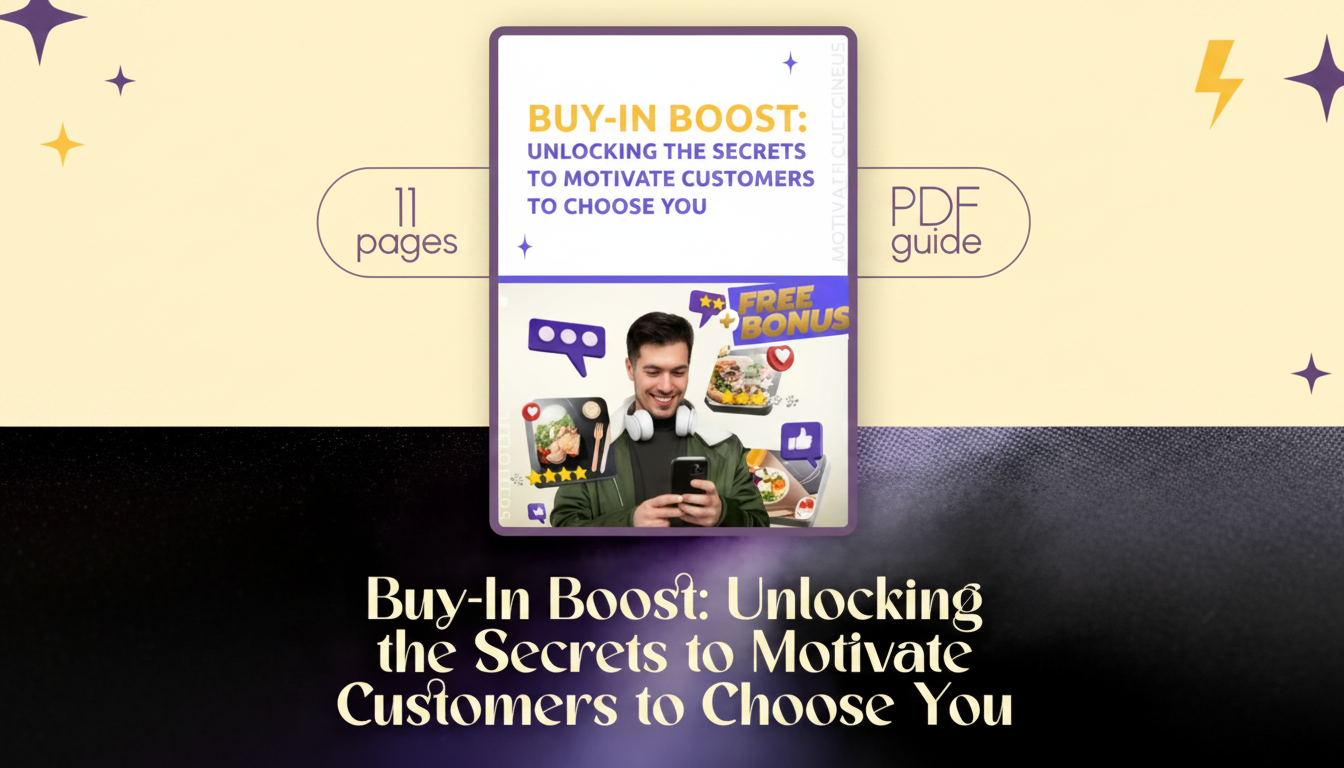
Buy-In Boost: Practical Ways to Motivate Customers to Choose Your Product
Customer decisions are rarely about logic alone. The strongest offers connect value to a real problem, reduce perceived risk, and make the next step feel easy. This guide breaks down the key drivers behind customer buy-in and turns them into clear actions—positioning, messaging, proof, and friction removal—so more people confidently choose your product.
What “buy-in” really means (and why customers hesitate)
Buy-in is the moment a customer believes a product will work for their situation and feels safe acting on that belief. It’s not just “liking” an offer—it’s trusting the outcome enough to commit.
Hesitation usually comes from predictable places: unclear outcomes (“What will this do for me?”), too many choices, fear of wasting money, lack of trust, and uncertainty about fit (“Is this made for someone like me?”). When those questions linger, motivation drops.
Momentum rises when the path feels simple: understand → trust → decide → act. Your product page, emails, and ads should support that sequence—especially the “trust” and “fit” pieces that customers often can’t infer on their own.
Start with the outcome: define the change your product creates
People don’t buy features; they buy a better “after.” Describe the before-and-after in plain language: what improves, what gets easier, what stops hurting, what becomes more consistent.
A fast way to translate features into benefits is to bridge them with: “This helps you…” followed by a measurable or felt outcome. For example: “This helps you write a product page faster,” “This helps you reduce decision fatigue,” or “This helps you feel confident hitting publish because you have proof and structure.”
Keep one primary promise per page or section. Multiple promises force the customer to choose which one to believe, and that added effort often becomes a quiet “maybe later.”
Map the 5 motivation triggers customers respond to
When buy-in is weak, the fix is rarely “more hype.” It’s usually one missing trigger: clarity, relevance, confidence, low risk, or momentum.
| Trigger | What the customer is thinking | What to include |
|---|---|---|
| Clarity | “What is this, and is it for me?” | One-sentence value statement, who it’s for, quick summary bullets |
| Relevance | “Does this match my situation?” | Use-case examples, scenarios, segment-specific callouts |
| Confidence | “Will this actually work?” | Process overview, results, testimonials, sample pages/screenshots |
| Low risk | “What if I regret it?” | Guarantee/refund terms, transparent policies, FAQs, support info |
| Momentum | “Can I start and see progress fast?” | Fast-start steps, first milestone, onboarding guide, preview chapter |
These triggers show up in classic persuasion research and behavioral economics: people lean toward options that feel safer, clearer, and easier to evaluate under uncertainty. For deeper background, see Robert Cialdini’s Principles of Persuasion and an overview of behavioral economics concepts from The Decision Lab.
Positioning that makes choosing you feel obvious
Strong positioning does a quiet but powerful job: it narrows the audience so your message can get sharper. Choose a clear slice—by role (creator, marketer), goal (increase conversions), stage (launching, rebuilding), or pain point (low trust, confusing offers)—and write directly to that person.
Differentiate with “why now” and “why this way.” That might be a unique method, a simple framework, or a constraint-based promise: faster setup, fewer moving parts, less overwhelm, fewer decisions. Customers don’t need you to be the only option; they need you to be the most sensible option for their moment.
Replace broad claims with boundaries. Say what it helps with, what it doesn’t, and who should skip it. Counterintuitively, honest limits often increase conversions because they increase trust.
Messaging that removes doubt without sounding pushy
Buyers respond to specifics, not pressure. Use concrete language: time saved, steps reduced, fewer mistakes, a clearer plan, or better consistency. If the customer can picture the change in their week, the offer feels real.
Address the top objections directly—price, time, skill level, complexity, compatibility—without turning your page into a debate. A simple “If you’re worried about X…” paragraph or a two-question FAQ block can keep friction from stacking up.
Trust builders that work even for low-priced digital products
Reduce friction: make the next step effortless
Apply the framework: recommended digital guides
If you want a practical, repeatable way to build buy-in (without relying on discounts), start with Buy-In Boost: Unlocking the Secrets to Motivate Customers to Choose You (eBook). It’s designed to help shape offers and messaging around real customer motivation rather than guesswork—useful for product pages, email sequences, ads, and sales conversations.
For a more personality-driven motivation angle—especially if your audience includes peacemakers who avoid conflict and delay decisions—pair it with Waking the Peaceful Giant: How to Motivate Enneagram 9s (Digital Guide), which focuses on understanding what helps Type 9s move from comfort to committed action.
Quick implementation plan for the next 48 hours
FAQ
How do you motivate customers to buy your product without discounts?
Increase buy-in by making the outcome unmistakable, adding proof (previews, examples, testimonials), and lowering perceived risk with clear policies. A small, easy next step—like a sample or quick-start plan—helps the buyer feel confident without needing a price drop.
What makes customers choose one product over another when features look similar?
Customers choose the option that feels most relevant and least risky. Clear positioning, credible proof, and a process they understand usually outperform a longer feature list.
What should a product page include to increase buy-in quickly?
Use a one-sentence promise, define who it’s for, add scannable benefits, show previews or testimonials, and make terms transparent (pricing, access, refunds). Close with a single, clear call-to-action that stays consistent across the page.
Recommended for you

Was this article helpful?
Yes
No






Leave a comment