-
Shop
- Advanced Technologies
- AI Skills Mastery 2026 Collection
- Apple Accessories
- Arts, Crafts & Hobbies
- Best-Sellers
- Calvin Klein
- Car Accessories
- Christmas Collection
- Dating & Social Skills
- Denim
- 7FOR
- AGOLDE
- Antony Morato
- Armani Exchange
- Boss
- Brunello Cucinelli
- Calvin Klein Jeans
- Costume National
- Desigual
- Diesel
- Dolce & Gabbana
- Dsquared²
- Ermanno Scervino
- Fendi
- Gianni Lupo
- Guess Jeans
- Ichi
- Just Cavalli
- Lee
- Levi's
- Liu Jo
- Morgan De Toi
- Mother Denim
- Only
- Pepe Jeans
- Pinko
- Replay
- Tommy Hilfiger Jeans
- Valentino
- Vero Moda
- Digital Resources
- Car Buying & Ownership
- Cozy Feast Collection
- Emotional Intelligence
- Financial Education
- Home Styling & Organization
- Mindfulness
- Mindset
- Parenting & Child Development
- Pet Lifestyle & Wellness
- Positive Thinking
- Productivity
- Self Confidence
- Sleep Improvement
- Stress Management & Relaxation
- Travel Planning
- Yoga & Fitness
- Yoga & Mind-Body Practices
- Education & Learning
- Family & Parenting
- Fashion
- Accessories
- Alexander McQueen
- Bags
- Bags & Wallets
- Balenciaga
- Belts
- Blazers
- Blouses & Shirts
- Bottega Veneta
- Bottoms
- Brunello Cucinelli
- Burberry
- Chanel
- Chloé
- Dior
- Dolce & Gabbana
- Dresses
- Etro
- Gucci
- Hats & Hair Accessories
- Hoodies & Sweatshirts
- Jacquemus
- Jewelry
- Jil Sander
- Jimmy Choo
- Kiton
- Luggage
- Luggage Bags
- Men's Fashion
- Miu Miu
- Off-White
- Outerwear
- Prada
- Rick Owens
- Saint Laurent
- Skirts
- Socks & Tights
- Sunglasses
- Sweaters & Cardigans
- The Row
- Tom Ford
- Tops & Shirts
- Valentino Garavani
- Versace
- Vivienne Westwood
- Watches
- Fashion Accessories
- Furniture
- Gadgets
- Health & Beauty
- Health & Wellness
- Home & Garden
- Home Supplies
- Kids & Babies
- Lighting
- Patio, Lawn & Garden
- Personal Growth
- Pet Care
- Pet Supplies
- Pets
- Shoes
- Sport & Outdoors
- Super Deals
- Thanksgiving Digital Collection
- AI & Tech-Enhanced Thanksgiving
- Budgeting & Smart Shopping
- Eco-Friendly & Sustainable Thanksgiving
- Family & Kids
- Gift Ideas Guides
- Gratitude & Mindfulness
- History & Meaning
- Hosting & Planning
- Leftovers & Storage
- Pets & Thanksgiving
- Social Media Captions & Ideas
- Thanksgiving DIY Ideas
- Thanksgiving Recipes
- Thanksgiving Products
- Travel
- Wealth
- Wealth Building
- Budgeting & Saving
- Cryptocurrency Investing
- Debt Management
- Entrepreneurship & Business Growth
- Family Finance & Budgeting
- Financial Independence
- Financial Mindset & Psychology
- Financial Planning
- Frugal Living & Expense Hacks
- Goal Setting
- High-Income Skills
- Investing Basics
- Leadership
- Motivation
- Networking & Mentorship
- Passive Income Strategies
- Real Estate Investing
- Side Hustles
- Stock Market Investing
- YouTube Shorts Best-Sellers
Stop Overthinking Conversations: Micro-Pauses That Work

Quiet Your Mind in Conversations: Stop Overthinking and Speak With Ease
Overthinking during conversations can feel like trying to talk while a second, louder conversation runs in the background—replaying what was said, predicting what might go wrong, and scanning for signs of rejection. The good news is that the mind can be trained to shift from performance mode to presence. With a few practical tools—micro-pauses, grounded body cues, kinder self-talk, and simple conversation structures—it becomes easier to listen, respond naturally, and recover quickly when a moment feels awkward.
If anxiety is showing up often or intensely, it may help to learn more about how social anxiety works from trusted sources like the National Institute of Mental Health and the Association for Behavioral and Cognitive Therapies.
Why the mind races mid-conversation
When the nervous system decides a social moment is “high stakes,” the brain tries to protect you by analyzing everything. Unfortunately, that protective mode often makes conversation harder.
- Threat scanning: social anxiety can treat neutral moments (silences, facial expressions, tone shifts) as danger signals, triggering mental over-analysis.
- Mind-reading and fortune-telling: assuming others are judging, or predicting embarrassment, increases self-monitoring and reduces spontaneity.
- Working memory overload: tracking “how am I doing?” uses the same mental bandwidth needed for listening and forming responses.
- Safety behaviors that backfire: rehearsing lines internally, avoiding eye contact, or over-explaining can make the conversation feel less connected, reinforcing worry afterward.
Common overthinking loops and quick re-anchors
| Loop | What it sounds like | Re-anchor in 10 seconds |
|---|---|---|
| Mind-reading | “They think I’m boring.” | Name it: “mind-reading.” Return attention to their last sentence and ask a follow-up question. |
| Perfectionism | “I must say something smart.” | Aim for connection over performance: reflect back one detail and share one simple reaction. |
| Replay spiral | “Why did I say that?” | Shift to the present sensory cue: feel feet on the ground, soften shoulders, exhale slowly. |
| Silence fear | “I have to fill the gap.” | Use a micro-pause: inhale, look at the person, then respond; allow 1–2 seconds of quiet. |
The micro-pause method: respond without rehearsing
A micro-pause is a tiny, deliberate break that tells your body and brain: “We’re safe enough to stay present.” It also interrupts the urge to over-explain or rush into the “perfect” response.
- Pause on purpose: a short pause before replying reduces impulsive filler and gives the nervous system time to settle.
- Use a physical cue: gently press tongue to the roof of the mouth or feel both feet to signal “present time.”
- Label the moment: silently say “pause” or “listen” to interrupt mental commentary.
- Reply in one clean sentence: answer simply first; add detail only if needed. Simplicity lowers pressure and keeps you engaged.
Try it in low-stakes settings (checkout lines, brief coworker chats). The goal isn’t to sound polished; it’s to build a repeatable pattern: pause, orient, respond.
Mindfulness during conversation (without becoming self-conscious)
Mindfulness in social moments doesn’t mean monitoring yourself more. It means gently moving attention from “How am I coming across?” to “What is happening here, right now?”
- Anchor externally: focus on the speaker’s meaning rather than your internal performance scorecard.
- Use “soft focus” attention: notice tone, key words, and emotion; let minor distractions pass without wrestling them.
- Allow natural imperfection: awkward moments happen in every relationship; treating them as normal reduces the urge to overcorrect.
- Reset with a single breath: breathe out slightly longer than you breathe in to reduce physiological arousal.
- Practice “one task”: listening is the task; planning the next line is optional and often unnecessary.
One practical cue: aim to remember one specific detail the other person shared (a place, a name, a feeling). This naturally steers attention outward and makes follow-ups easier.
Conversation structures that reduce pressure
When anxiety spikes, structure helps. A simple framework reduces the “infinite options” feeling that can trigger blanking out.
After-conversation rumination: how to stop the replay
If rumination is persistent and disruptive, resources from the American Psychological Association can provide a helpful overview of anxiety and support options.
A guided workbook approach for calmer communication
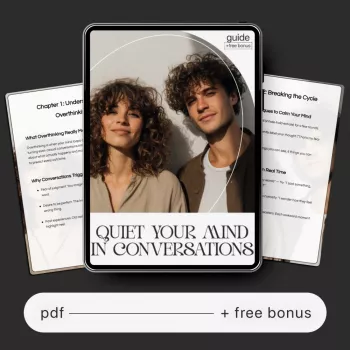
If you want a step-by-step, practice-focused option, consider Quiet Your Mind in Conversations: How to Stop Overthinking Every Conversation (eBook).
For people who tend to keep the peace and go quiet under pressure, a complementary read is Waking the Peaceful Giant: How to Motivate Enneagram 9s (Digital Guide), which focuses on building momentum and self-advocacy—useful skills when conversation anxiety leads to holding back.
FAQ
Why do conversations feel harder when trying to “be normal”?
Trying to “be normal” often turns the interaction into a performance, which increases self-monitoring and steals attention from listening. When you shift from image-management to connection—tracking meaning, emotion, and one or two key details—conversation tends to flow more naturally.
How can overthinking be stopped in the middle of a conversation?
Use a quick sequence: take a micro-pause, feel your feet or soften your shoulders, silently label the thought (“mind-reading”), then ask one specific follow-up based on what they just said. Respond in one clean sentence before adding extra detail.
What if awkward silence happens?
Silence is normal and often gives both people a second to think. Allow 1–2 seconds, then use a simple reflection (“That makes sense”) or a specific follow-up question instead of rapidly changing topics to escape the gap.
Recommended for you


Was this article helpful?
Yes
No








Leave a comment